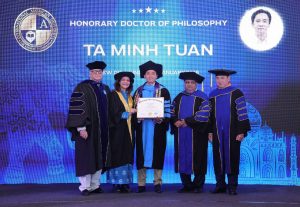
Beyond being an exemplary social entrepreneur with many business projects addressing social problems, Tạ Minh Tuấn has a frank, practical view of how young people express patriotism today.
Nurturing entrepreneurial aspirations since his university days, Tạ Minh Tuấn has tasted failure many times, yet turned those failures into motivation to rise and become a pioneering entrepreneur in several business fields still relatively new to Vietnam.
A young man of the 8x generation (1988), Tạ Minh Tuấn currently leads several businesses and social organizations, most notably HELP International and its “Personal Doctor – Home Healthcare” model.
Tạ Minh Tuấn's entrepreneurial story may offer valuable lessons for young people who dare to think and act and want to contribute to the country, especially amid today's many opportunities and changes.
BizLIVE had a brief conversation with entrepreneur Tạ Minh Tuấn to hear his thoughts on the social enterprise model he is pursuing and his perspective on how young people express patriotism today.
HELP International is known as one of today's very successful social enterprise models. When you first began building HELP, did you intend to develop this business model into a social enterprise?
HELP was initially built with the wish that every person could have a personal doctor monitoring their health at the most affordable cost. For greater convenience, the doctor would visit their home for examinations, so we developed an entire system we define as “healthcare at home” to address many problems in Vietnamese healthcare.
A “social enterprise's” journey usually begins before the business truly understands the concept. So at first, I did not know or define HELP as a social enterprise. Yet both before and after official recognition as one, our business philosophy and direction remained unchanged.
In your view, what role does the owner play in ensuring that a social enterprise operates true to its purpose?
I believe that the “core” of a social enterprise is the social entrepreneur. So as long as that entrepreneur remains strong enough to hold on to their beliefs, ideals, vision, mission and core values, the enterprise will not “stray off course” and become a purely commercial business.
A social entrepreneur's core inner motivation and reason for founding the business are very important; they play a substantial part in determining the path they should and need to follow. I have experienced this feeling, so I understand it. “Social enterprise” cannot be a “coat” we put on whenever we want to look more beautiful and dazzling. It must truly come from within, meaning that we must first have the heart of a social entrepreneur.
I believe social entrepreneurs can be both “born” and “made.” “Born” means they possess the qualities of social entrepreneurs from the beginning. “Made” means they may not initially have them, but real-world environments and experiences create and transform them, forging the “heart” of a social entrepreneur.
Does that mean you had already cultivated the heart of a social entrepreneur at that point?
I believe my mission is “empowerment.” I regularly promote activities that empower patients, learners, young people, and communities. For patients, for example, how can we help them be less passive (only seeking treatment when ill), less dependent on doctors, and able to become “their own best doctor”?
Of course, the physician's role remains very important, but patients need knowledge, skills and tools to take an active role in caring for their own health, perhaps even at home. That would also “free up” the physician, enabling them to see more people.
That is why I will keep creating whatever “pieces” are needed to fulfill this mission, without stopping. Fate often makes me a pioneer, initiating something that does not yet exist and that others have not done (rather than not thought of). And there are still so very many “market failures” awaiting my contribution to solving them.
I am currently developing a healthcare project using a new concept I call “Smart Healthcare,” and two education projects. One is “Entrepreneurship Education,” addressing many problems in Vietnam's current startup market: short-term thinking, severe gaps in knowledge and skills, and insufficient support for success. The other will use technology to “empower” both learners and teachers more.
You seem very busy with business projects tied to solving social problems. Have you seen many opportunities to develop social enterprise models in Vietnam today?
There are many opportunities, but an important criterion in deciding whether to seize one is the “social impact” of what I do or do not do. That is my basis for decisions. Therefore, the projects I undertake will continue to use this criterion as their “root,” their foundation for action.
Social enterprises in Vietnam are receiving increasing attention. A legal framework has also been proposed, and there may be specific laws supporting their development in Vietnam. The concept of “social enterprise” is no longer an ideal or a movement; it is growing stronger, with its own legislation, system, and considerable specialized knowledge.
I believe the road ahead is bright. The real challenge, however, is whether Vietnamese social enterprises can address finance, staffing, and relationships with social resources, and scale their social impact. Not only must a supporting ecosystem form around them; they themselves must mature.
In reality, many young people also aspire to become wealthy and contribute to society, but not everyone can recognize and seize opportunities. What do you think is their greatest limitation here?
Young people often say they have no money to start a business. But instead of thinking “give me money and I'll start,” why not ask “is there a way to start without needing money yet?” Hearing this, many immediately impose the judgment: “That's unrealistic thinking; what can you do without money?”
I feel pained by the reality that many young Vietnamese people have impoverished thinking and lack depth. For them, the “entrepreneurship game” ends before it begins. They are not defeated by the market but by their own “impossible” mindset.
The first challenge does not lie with investors, employees, or customers… but within the entrepreneur's own mind. They need to understand that the “right moment” for “perfect resources” will never come; something will always be missing. If they do not start, they will never have it. The point is to choose a lean, intelligent way to begin, avoiding heavy losses and saving resources for the truly difficult stage ahead—the market stage.
At a time when maritime and island sovereignty is threatened, patriotism is rising among many Vietnamese people, especially the young. They are doing many things to demonstrate it, but not all bring positive results. In your view, what is the most practical way to show patriotism today?
The surging patriotism is an encouraging sign that young people are not indifferent, but patriotism needs a warm heart and a cool head. “If I were a bird, I would be a white dove… If I were a flower, I would be a sunflower…” We greatly need actions oriented toward peace, light, goodness, and higher values.
At this moment, I believe patriotism means doing your own work as well as possible. Do you “leave rubbish” for others to “clean up”? Have you truly worked responsibly? Do you know that Vietnam's labor productivity is only 1/15 of Singapore's? If our country is wealthy and strong, I believe it will be better protected.
For entrepreneurs, growing their businesses, creating jobs for many people and making quality products that bring people joy and happiness are also very practical acts of patriotism.
ĐINH THƠM – Diễn Đàn Đầu Tư newspaper