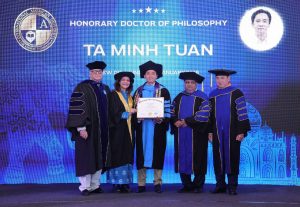
When discussing social matters, many businesses tend to think of charity. But one very young entrepreneur has made social purpose his reason for living, business philosophy, career and passion. That is social entrepreneur Tạ Minh Tuấn.
Impressed by two prestigious awards, both selected by reputable organizations and normally intended for major businesses, anyone speaking with Tạ Minh Tuấn — Founding Chairman and CEO of HELP International and founder of YUP Insitute — encounters surprises one after another. This is not only because of the inspiring ability and energy of an entrepreneur and speaker, but because of entirely new concepts and ideas within a great aspiration: the aspiration to change the world through positive thinking.
Why did you choose education and healthcare for your businesses when other young people often choose trendier fields such as fashion or entertainment, or, most commonly, opening a café?
I believe that before doing anything, we need to consider whether it aligns with our goals, whether we have the right “affinity and conditions” for it, and what positive social impact it will bring. There are thousands of things we want to do, plenty of ideas and no shortage of projects waiting; what is lacking is people to carry them out. Each person has only one life to live, so we all have our own criteria for deciding what takes priority and what is important to do. A long journey must begin with small steps. But those small steps must head toward the goal; wandering aimlessly can easily lead to defeat.
Many say healthcare and education are ‘super-profitable’ sectors that have produced many tycoons. What do you think about this?
Actually, that assessment is not comprehensive. These are two fields in which the private sector still faces many difficulties. To me, healthcare and education are the two fields with the greatest “inertia” in Vietnam today. I think that where others are already doing something well and can do it even better, we should let them do it and support them. But what about work that few people are willing to do, perhaps because it is difficult or not yet attractive, but which would bring great value to society if accomplished? If I have an affinity for that work and can do it, why not? Both my parents are educators, so I already have the “genes”; sooner or later, I would follow the path of education. Especially now that I have found my own path, I want to create a shortcut for young people with ambition and commitment.
Why did you come up with the idea of creating a home healthcare model? What do you predict about the trend toward “private” or personalized services, not only in healthcare?
A family member became ill, bringing me into medicine and inspiring me to establish a preventive healthcare model to help prevent illness in society. My mission was to make this model widespread in Vietnam, with active support from the government and community. By now, I can say I have partly fulfilled that mission and moved on to a new one.
Looking at the United States, healthcare costs rise by 9% each year and account for 20% of the country’s GDP. Who must bear these costs? The patients? Instead, we can think differently. Is there a way to reduce costs? In healthcare today, patients no longer stand on the sidelines; they take a very active role in their own treatment. Keeping both patients and their personal doctors up to date with the patients’ personalized information is essential for predicting and preventing illness, thereby reducing treatment and emergency care costs by a factor of 20-100.
This trend is necessary not only in healthcare, but in almost every field. It is fastest and most visible in Internet-related sectors (and nowadays, few industries seem unrelated to the Internet). When you visit Facebook or use Google's search engine, these giants already hold personalized information about you to promptly suggest what you need. That is wonderful, but it also has downsides, like a future in the film ‘Big brother is watching you.’
Six golden words in entrepreneurship
Known as a leading expert on “smart entrepreneurship,” could you share your ultimate startup lessons?
I have developed 6 elements into a tool whose copyright I hold, called the “Smart Entrepreneurship Tool.” Detailed analysis would take time, so I summarize it here into 6 points: 1. Does this business project meet present and future market needs? (Market); 2. Do you have a clear competitive advantage with this project? (Competence); 3. Is it your passion? (Passion); 4. What social impact does it create, positive or negative? (Social Impact); 5. Do you fully understand the necessary and sufficient legal conditions to operate now and expand the model in the future? (Legal); 6. Can your business model scale? (Scalability).
So what is different about social entrepreneurs? Which values guide their lives and businesses?
Today's world has many problems waiting for us to solve together: weaknesses in education, healthcare opportunities for the poor, gender equality, employment for people with disabilities, life skills training for street children, reducing environmental pollution… Many “systems” are operating and, at first glance, seem to have reached equilibrium, but are actually “producing” quite a few problems for society.
From a business perspective, wherever there is a problem or a need, there is an opportunity. But when social entrepreneurs find a “malfunction” in a system somewhere in this world, instead of adjusting themselves to the status quo, they try to transform the system into another state — one that works better. Social entrepreneurs' efforts are transformative, not merely soothing, with the power to create a catalyst that helps shape the future.
Successful people adapt to change, master change, and help others change proactively. That is why I believe that in life and business, social entrepreneurs all pursue the value of positive changes—changes that can bring breakthrough solutions to an existing social problem. Sometimes the way they create those changes is extremely… unreasonable. But that is their strength. They place the supreme goal of solving society’s problems above financial goals. Of course, money is one of their measures, and their solutions must be effective enough to ‘regenerate’ money.
You received 2 awards related to “social entrepreneurship” simultaneously, selected by very reputable organizations. Are these awards naturally earned recognition, or were they your goals?
“Social entrepreneurship” is only for large businesses if we view it as a communications and branding activity whose essence is also profit maximization. In reality, “social enterprise” is not about being large or small, but about the ultimate goal the business pursues: maximizing profit or maximizing social impact.
Previously, people often spoke of trade-offs, such as choosing either profit or ethics. Today, I believe successful businesses deliver “dual value” (trade-on), or what we previously called win-win. For example, when Alibaba succeeded in China, it also helped farmers sell many products through its e-commerce platform. As a major corporation, Viettel's general director declared a desire to use technology's power to give the entire country access to the highest-quality education. These exemplify businesses becoming more successful as they care more about society, and vice versa.
In the years ahead, there will no longer be a distinction between social enterprises and most of today's major companies — this is essential to the progress of business.
Regarding the recognition society has given me recently, I want to say: keep walking your own path, and along it, receive the ‘fruits’ that come as the result of worthy efforts. Simply follow nature's course!
Thank you!
Hoài Anh – Doanh Nhân Magazine (implement)