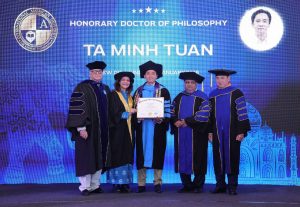
The door opened, and a few people in a corner of the restaurant recognized Tạ Minh Tuấn. Within seconds, men around 40 turned their attention entirely toward him, each greeting him, “Hello, Teacher!”
The young teacher approached and high-fived each student. The hot, quiet midday restaurant suddenly became lively. Tuấn moved to another corner for a private meeting.
The game changer
The entrepreneur students returned to their meeting. But the wave of energy had already spread. Every subtle movement in this space seemed to carry a different rhythm.
I had heard of Tuấn for a long time, but only in those brief first moments did I witness the activating energy of this young man known as the ‘inspiration superhero.’
“A young man starting a business for reasons other than circumstance” is Tuấn's self-deprecating description of his decision, once considered… “a little crazy,” when he had just entered university.
In his first startup at 19, while a second-year Industrial Systems Engineering student at Ho Chi Minh City University of Technology, Tuấn co-founded one of Vietnam's earliest digital marketing service companies.
With the rationale ‘do it to learn,’ Tuấn and the founding team plunged into market research, fundraising, recruitment, and finding customers. Like an ‘alien object’ in Saigon's marketing world at the time, the business went from having no customers for its first three months to becoming a communications partner for major brands such as Samsung Vietnam, Sony Vietnam, and Unilever Vietnam…
But Tuấn’s student years also began to become… ‘unlike anyone else’s.’ There was a period when he hardly attended classes and had no time to prepare for exams. At night, when there was no one left to… work with, he began reading and teaching himself the material he had missed in class, both to maintain his knowledge and to… apply it to his startup.
Working flat out twenty hours a day, during some exam seasons simply “showing up for the exam at the right time and in the right room” was already a… major effort. Even so, in his specialist subjects, Tuấn almost always ranked among the highest scorers in the class.
As Tuấn grew accustomed to seeing himself as “unlike anyone else,” he nurtured other “unconventional” ideas. He founded Help International.
At that time, family doctors were still an image seen only in foreign films, while in Vietnam people were spending enormous sums on treatment rather than prevention. He entered education with the YUP Entrepreneurship Academy when “startup” was still a newly discussed concept in Vietnam.
He established the Dream of Angel Feet fund – a charity supporting people with disabilities who have a passion for literature and the arts, at a time when dreams beyond making ends meet are still considered a luxury for people with disabilities. Then he founded Vietnam Leaders Toastmasters, bringing the spirit of the world’s largest public speaking association (Toastmasters International) to Vietnam…
Starting at 19, at 23 he was recognized by the British Council, CSIP and the World Bank as one of Vietnam's 15 outstanding social entrepreneurs. At 27, Forbes named him among Vietnam's 30 most successful and influential young people. At 28, he made the list across all of Asia—each turning point marking another occasion when Tuấn entered and changed
the game.
Discover yourself
But ‘every milestone is only one chapter of life.’ For Tuấn, achievement is not necessarily the brands attached to his name when people mention Tạ Minh Tuấn, but those moments of looking back at himself in astonishment after passing through all the struggles and confusion.
When founding Help, Tuấn carried a powerful drive after cancer suddenly struck his father. At the time, he was working relentlessly toward his university degree while struggling with the digital marketing company.
A family crisis shook everything. His father’s illness was painful, but the helplessness when the bad news struck tormented Tuấn many times more.
Thinking of other families with seriously ill loved ones, Tuấn realized that the pain of illness always strikes suddenly, because disease develops silently amid Vietnamese people's indifference to health.
The family doctor model emerged from there. Tuấn began researching, planning, and committing himself to organizing a team of doctors who would make home visits, monitor, and manage people's health issues.
But when entering and opening up an uncharted land, the pioneer also crosses and tears through their own limits.
Some afternoons, riding his motorbike from school to District 1 to meet investors, Tuấn had to park several turns away and walk to the appointment. Reaching the address, he looked up at the city's tall building, then down at himself: a student dreaming of “change,” rushing back and forth to meet, persuade, and hear rejection from over twenty investors.
Tuấn suddenly thought, “What am I doing here?” The prospect of carrying a stack of papers into a luxurious, unfamiliar office and telling his dream to an unfamiliar senior entrepreneur, having that “dream assessed” for the nth time, left him exhausted.
The thought of fleeing flashed through his mind. He hesitated, then pulled himself together and walked inside. After that meeting, he received hundreds of thousands of dollars in funding, the first confirmation of the project’s viability.
One afternoon during those days faded by road dust, his body gaunt from staying up nights nurturing his “child,” Tuấn received a notice from the Ho Chi Minh City Department of Health ordering the project to stop, because… Vietnam had not yet finalized its family doctor legislation at that time.
Frantically contacting everyone, Tuấn received only one answer: stop the project! At the time, everything was progressing, every colleague was ready and enthusiastic, and organization, expertise, and finances were all in place. The project itself had no problems, except having to… stop implementation.
In an emergency meeting amid a crisis, facing a deeply bewildered team, Tuấn offered only this reassurance: “We'll find a way!” After leaving the meeting room, having high-fived and lifted their spirits, he cried like a child all the way home.
Thinking of his father, his dedication in the early days, the painstaking care for the service, and this cruel challenge, he felt helpless. Arriving at the gate, Tuấn threw away his mask soaked with tears, restored a cheerful expression, and entered the house. He was only 22 then.
The venture never stopped presenting challenges. Born with and nurturing an ambition to improve Vietnamese people's healthcare, Tuấn defined his ideal of building Help International as a social enterprise.
Later, when Help International was operating steadily as a general internal medicine clinic with a ‘personal doctor’ service for patients who needed it, Tuấn again clashed with the investor over the company’s development goals.
The conflict escalated as more misunderstandings arose. At a meeting, one of the company's most respected investors angrily pointed straight at the “founder”: “Tuấn, if you don't change, starting tomorrow you are not to set foot in this company again!”
That possibility was real. If their ideals could not be reconciled, the investors could indeed fire Tuấn, even though he was Help's founder and operator. Faced with that make-or-break moment, Tuấn fell silent.
The meeting ended. Fortunately, during that crisis, 99% of company staff sided with Tuấn. He began resolving the financial issues and “parting ways” with the investor who did not share his ideals.
Recalling that painful memory, Tuấn shared: ‘I also bear responsibility for choosing an investor focused on recovering capital quickly and maximizing profit, while the project’s vision required great patience.’
“The more experience people gain in this game, the more they understand that they must take 100% responsibility for their lives!” Tuấn confided.
But on that fragile tightrope of gains and losses in business, only one thing retains its value: a pioneer’s spirit of commitment.
In 2013, Tuấn was twice invited by the National Assembly's Committee on Social Affairs (under the Ministry of Health) to attend a conference on community healthcare in Vietnam as a family healthcare practitioner. A young man trained in engineering with no medical expertise, Tuấn stood at the conference for the first time, presenting his dedication and vision for the family doctor model to experts and senior healthcare officials.
At the end of the conference, a few officials patted Tuấn on the shoulder enthusiastically: “Well done! Go ahead—I'll support you wholeheartedly!”
After many years struggling to maintain and nurture the project, this was the recognition that surprised and moved Tuấn most.
Only a short time later, at the end of 2014, the National Assembly passed a law on family healthcare. Tuấn's proposal to include family doctors in health insurance services to serve the poor also gradually began to be applied.
Tạ Minh Tuấn had by then become a prominent name in the business and youth communities through YUP Entrepreneurship Academy.
Opposite me, the entrepreneur suddenly became a dreamy, playful university student as he spoke about J.O.B. — a book-lending project whose Vietnamese name means “Journey of Book.”
During a month-long entrepreneurship course in Israel—the Jewish nation renowned for startups—Tuấn visited the founding father's home and was amazed by long shelves holding more than twenty thousand books. He learned that one of Israel's founding father's final wishes remained unfulfilled: turning his home into a library where people could read for free.
Returning to Vietnam, Tuấn began planning a free library where Vietnamese people could contribute books or easily enter the world of knowledge by borrowing them for free. Another adventure in knowledge begins…