Around me, there are plenty of stories of executives at major corporations who, despite brilliant previous success, still failed when starting their own businesses. Surprisingly, their failure rate is no lower than that of people who start businesses from the outset without first training in a professional environment that could provide valuable knowledge and skills. With such advantages, shouldn't success be easier for them?
To understand the causes behind this “phenomenon.” We need to take a step back and examine 2 concepts that seem like 1 but are actually 2, appearing similar but very different: Start-up and Company.
Many people are confusing these two concepts.
Company is a a business organization currently sell a product or services somewhere to bring in revenue and profit.
Thus, a Company’s business model is very clear. And the goal of a Company is to maximize profit.
Startups, however, are different.
The goal of 1 “Startup” is… to no longer be a startup.
That means the startup must reach another state: becoming a company.
So what is a ‘Start-up’?
A startup is a a temporarily designed organization (temporarily designed) to find (search) a business model (business model) repeatable (repeatable) and scalable (scalable).
Thus, the ‘ultimate goal’ and ‘highest mission’ during the startup stage are not yet to maximize profit, acquire many customers, or increase brand value (these things must still be done, but they are not the most fundamental goal at this stage)… The goal at this stage is for the startup to conduct many ‘experiments’ and continuously ‘adjust’ its business model to establish one that is viable, solid, profitable, standardizable, scalable, and sustainable.
That is why MBAs, people taking professional CEO training to become hired executives at large companies, and people who acquire business knowledge and skills while working at international corporations — even though they have succeeded in a much larger environment — can so easily fail when founding 1 Start-up.
Because the thinking, knowledge, and skills they possess all belong to the “Company” stage.
The “Startup” stage requires entirely different thinking, knowledge, and skills. They lack these, or are complacent: “They don't know what they don't know.” At this point there is a Gap between what they know and what actually helps them get through the Start-up stage.
Only those who know how to adapt and forget the old to make room for the new can succeed. For example, I once knew a manager at Unilever who, after leaving to start a business, needed 3 years to truly “unlearn” the thinking he had learned at U before succeeding as an entrepreneur.
To make this clearer, people who work at large companies have the advantage of a clear industry perspective and good skills, but sometimes they suffer from a “condition”: wanting to standardize everything too early, establishing complete processes and applying all sorts of “tools,” such as BSC, to their businesses.
But they forget that large companies and corporations have had hundreds of years of experience to ‘know what is right for them,’ and only then standardized everything. A startup is still on a journey to find the ‘truth’ for its business model. Rushing to standardize will backfire. It is like having a rope (resources), but using it to tie your own hands and feet, making you move slowly and laboriously and miss every opportunity.
Sometimes a Start-up's only strength and competitive weapon against the giants is Speed. In this case, old habits, old methods and old ways of thinking led these “entrepreneurs” to standardize everything too early, making the whole startup operation too “cumbersome.” They thus abandoned their only advantage, speed, and plunged straight into the abyss already visible ahead.
And that is only one of the old habits that make someone successful in a large corporation, yet not necessarily more likely to succeed in a startup.
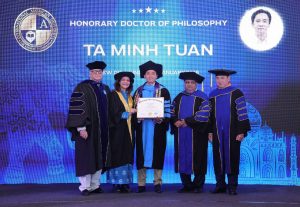
Tạ Minh Tuấn – TMT – is a successful entrepreneur pioneering several startup fields in Vietnam, 1 of Vietnam's 30 most outstandingly successful and influential people in the prestigious “30 Under 30″ ranking by Forbes, the world's leading business magazine, and the founder of YUP! Start-Up Education & Incubation Centrer (www.yup.edu.vn).