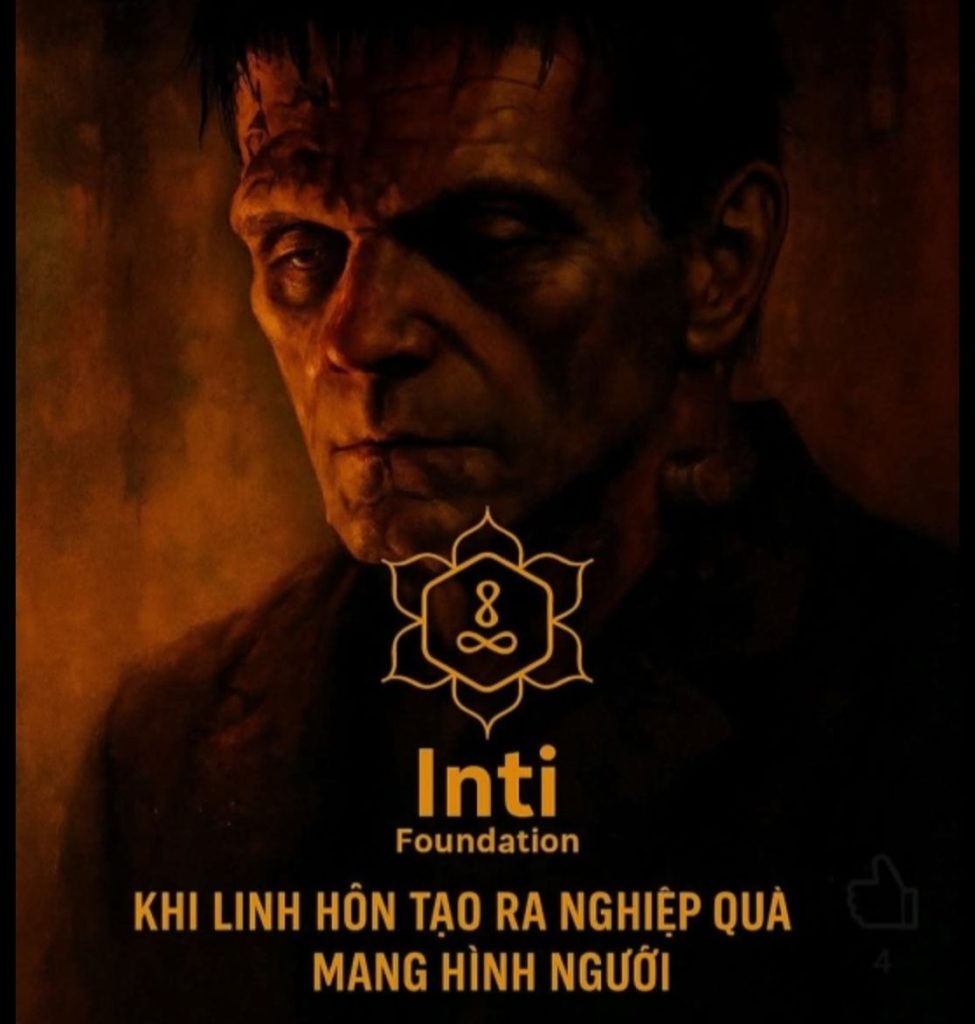
Frankenstein is a symbol hidden deep within humanity's collective unconscious… That is why so many people resonate with it.
Because humans always want to “seek” their Creator, like abandoned or “lost” children — like Frankenstein always searching for “Father.”
Yet people themselves constantly reject the darkness within and have not truly faced, observed, understood, and transformed it—the ‘Inner Frankenstein,’ the ‘shadow child’ (because it has not been understood) in each person’s psychological structure.
It is an “inner tragedy” of pursuit and escape, of reflection in a mirror, of the many layers and dimensions of Cause – Effect or Creator – Creature within the consciousness of each soul.
1. Frankenstein – “your” own story, not Victor's
In the 2025 version, del Toro emphasizes that this is not a horror film, but an intensely emotional story viewed through his lens.
This makes the film a spiritual parable rather than a “failed scientific experiment.”
Viewed from the soul’s perspective:
Victor Frankenstein is not merely a mad scientist, but a symbol of the arrogant ego within each of us—the part that wants control, wants to exceed limits, and wants to “defeat” life and death.
The Creature is not a monster, but:
-The abandoned child within
-The rejected part of memory
-The living karmic consequences of ignorant actions
Elizabeth, Victor's father, the blind old man… are different aspects of the karmic energy field operating in Victor's life—and in your own.
From the film's very structure — divided into ‘Victor's story’ and ‘The Creature's story’ — del Toro shows us:
There is no “absolute truth” at the physical level. Every soul has its own story, yet all are true within the framework of karma.
2. The ambition to “outdo God” — or an unhealed fear of death
Victor's deepest motivation is not only “science,” but:
-The pain of losing a mother
-Resentment toward a strict father
-Helplessness in the face of death and injustice
From then on, he vowed to conquer death, to “create new life” from a corpse. This is the ego's ancient illusion:
“If I Have Enough Power, I Will Never Have to Hurt Again.”
But on the spiritual plane:
Every attempt to evade impermanence through control, rather than acceptance and understanding,
all lead to tragedy.
Victor does not truly love life—he only wants to control it.
God (or Source Consciousness) does not “punish” Victor.
It is precisely his ambition exceeding his inner maturity that produces bitter consequences:
When willpower exceeds wisdom
When power exceeds compassion
Whatever you create will return
Teaching you a very costly lesson.
3. The Creature – the rejected soul, our own karmic child
As soon as his ‘child’ comes alive, Victor:
-Tying it up in the darkness.
-Using violence to “teach a lesson” — exactly as his father treated him.
-Ashamed of it, afraid others will see it.
Spiritually, it is how we treat the wounded, rough, ‘ugly’ part within ourselves:
We lock it in the unconscious.
We strike and scold it: “You must not appear. You embarrass me.”
We pretend we are “fine,” “perfect,” and “spiritual,” while underneath is a child covered in stitches and cuts, crying out.
The Creature:
-That is Karma in the form of a “creature”:
-You create it through ideas, thoughts, emotions, and actions.
-When you reject it, it enters the forest of the unconscious.
-But it does not disappear. It grows in the darkness.
-And returning to knock on the door of your life just when you think you have “escaped”.
4. The blind old man – when we are seen through nonjudgmental eyes
The film’s second part, ‘The Creature’s Tale,’ is its most important spiritual gift.
The Creature hides in a blind old man's house…
The old man could not see outward appearances—he could only sense the intentions of the ‘Forest God’ helping him.
He taught it to read, speak and think…
And for the first time, the “monster” was treated as a soul with dignity.
This is a beautiful symbol…
The blind old man is pure awareness—unconditioned by appearance or prejudice.
In Meditation, when you close your eyes, you no longer see your own “exterior”; you only feel the life within.
It is when the “monster” within you is allowed to sit down, breathe and learn to tell the truth.
But even that refuge is eventually shattered by:
-The violence of the world
-Misunderstanding
-Fear of difference
The Creature realizes:
“I am immortal, but I have no home to return to.”
It is the ego's ultimate loneliness — even after gaining “power,” “longevity” and “immortality,”
if there is nowhere that understands us, the soul still feels out of place.
5. The bloody wedding – when karma intrudes into “happy” moments
William and Elizabeth's wedding night — seemingly the pinnacle of “worldly happiness” — becomes the climax of karmic consequences:
The Creature arrives and asks for a companion—not merely from desire, but from fear of eternal loneliness.
Victor refuses in disgust, denying even his responsibility as a “father.”
In the chaos, Elizabeth dies from Victor's own bullet, and William also falls.
The Universe seems to tell us:
You cannot build true harmony (harmony – the “wedding” symbol).
Upon those memories, that karma, and those children of the spirit you have locked in darkness (karmic memories not yet understood and purified).
They will enter the party, inviting you to face them — one way or another.
6. The pursuit across ice and snow – the ego chasing its own karma
Entering the final part, we see the image:
The ship was trapped in ice.
Victor, disabled and haunted…
Frankenstein repeatedly expresses, “Pay attention to me.”
This is not merely a cinematic “chase scene,” but a portrait of:
-The mind (Victor) refuses to let go.
-Karmic consequences (Creature) force the mind to look.
-The blockage of trapped, frozen, unreleased emotions (The ship trapped in ice).
When The Creature steps aboard the ship, everyone must face the truth:
-Victor acknowledges: “You are my son.”
-The Creature calls: “Father.”
-Anderson gave up his obsession and ordered a return home.
This is the moment of karmic release:
A. Acknowledgment:
When you stop treating the darkness within as an “enemy”…
And acknowledge it as the “child” of your own thoughts, actions, and choices,
At that very moment, the deepest layer of karma begins to dissolve.
B. Apology and forgiveness:
Victor apologizes and calls it his child.
The Creature forgives him, allowing him to die peacefully.
C. Letting go:
Anderson turns the boat back – meaning the mind knows when to stop…
No longer encouraging ego-driven pursuits.
Then the ice melts and the ship is freed—as if symbolizing the beginning dissolution of individual and collective karma.
7. The final light – when the “monster” becomes a “saint”
Closing frame:
-The Creature stands on the ice.
-Reaching out to receive the sunlight — the light Victor once taught it to recognize.
-The ship drifts toward dawn.
Guillermo del Toro once said that since childhood he saw Frankenstein more as a saint or Savior than a devil.
In the film, that idea is perfected…
The Creature remains alone, without family or others of its kind.
But it itself:
-Freeing the ship.
-Ending the flow of violence.
-Forgiving the father who created and tormented oneself.
This is a very elevated layer of meaning:
-The “monster” within you, if you look deeply at it, embrace it, and take responsibility…
-Can become the “saint” who redeems your own life…
-By compelling you to mature, be humble, and learn to love.
On the journey of awakening…
You do not become a “spotless angel who has never made a mistake.”
You become a “mature soul” because you have:
-Daring to create.
-Daring to face the consequences.
-Daring to apologize.
-Daring to forgive.
-Daring to let go.
-Daring to stand alone in the light without seeking external recognition.
8. A few questions for your own meditation after watching the film
After watching Frankenstein, you can sit quietly for a few minutes and ask yourself:
A. Who is “Victor” within me?
Which part of me always wants to control everything and ‘go beyond the rules’ ?
What pain gave rise to it, and what memories involving parents, teachers, or society?
B. What is my “The Creature”?
Which emotions and wounds in my life have been locked away and deemed ‘ugly’ ?
What have I burned away, rejected or run away from?
C. Do I have a “blind old man” within?
I spend time sitting with myself in silence…
Like a blind person who does not judge appearances, but feels only with the heart?
D. What am I hunting on the “ice and snow”?
A title, a person, a dream, revenge?
If I let go of that pursuit, how might the ship of my life be set free?
E. Have I ever called the “monster” within me “my child”?
Look at a mistake, a bad habit, a dark aspect of your own character…
And say: “You are the result of what I have thought and done. I am sorry. I will take responsibility for healing you.”
If you are brave enough to look at Frankenstein as though looking at yourself…
You will realize:
There is no “monster” to destroy,
only children of consciousness that need to be acknowledged, embraced, and guided back to the light.
And that is the spirit of Awakening Meditation:
When you dare to see your whole self—both angel and monster…
You begin to enter true freedom.
Awakening Meditation
Saga