The principle of ‘Minimum effort for maximum results’ does not mean being lazy or not doing your best. On the contrary, you still need to give your all in everything, in every breath. The difference is to direct that ‘wholehearted effort’ well so you can create a great deal of value.

Born in 1988, Tạ Minh Tuấn studied Industrial Systems Engineering at Ho Chi Minh City University of Technology. He is co-founder of IDEE Corporation; founding chairman of HELP International, a pioneering and leading organization in building the ‘Personal Doctor – Home Healthcare’ model in Vietnam; and executive chairman and founder of the ‘Dream of Angel Feet’ charity fund. Tạ Minh Tuấn is also a young entrepreneur who has appeared on the Forbes Under 30 list and has been recognized by CSIP, the British Council and the World Bank as one of Vietnam’s 15 outstanding social entrepreneurs.
An alumnus of Lê Hồng Phong High School for the Gifted in Ho Chi Minh City, Tạ Minh Tuân had a secret that made studying calm and untroubled, rather than laborious as it was for his peers. He later skillfully applied this approach to business and entrepreneurship too.
Establishing a ‘zone of brilliance’
“Because I have my own ‘secret’: proactively directing my life by defining my personal ‘zone of brilliance,’ based on the inner factors of passion and strengths, combined with the outer factors of future market demand and an assessment of social impact,” Tạ Minh Tuấn shared in his newly released book.
According to him, the “zone of brilliance” is established by the formula:
Zone of brilliance = Internal factors + External factors
Internal factors = Passion + Strengths
External factors = Market demand + Social impact
Zone of brilliance => Proactively directing your life => Choosing a suitable field of study and career.
Using his own university choice as an example, Tạ Minh Tuấn says he consulted many people before selecting a major. First were his parents and older siblings, who had attended the University of Technology. He also liked engineering, so the university was a sensible choice.
After narrowing his choices—engineering as a profession, the University of Technology as his school—it was time to choose a specific major. Tạ Minh Tuấn researched every major offered and settled on Industrial Systems Engineering.
An Industrial Systems Engineer's job is to design a system, manage its operation, and continually seek improvements. They focus on industrial, manufacturing, and business operating systems. They do not specialize in one particular discipline; their specialty is… systems.
Everyone has their own “zone of brilliance.” Anyone who steps outside their “zone of brilliance” becomes as unremarkable as countless ordinary people, or even mediocre.
So systems engineers can work in many different industries, commonly manufacturing, and later also services, transport, logistics, supply chains… Worldwide, the IE engineer's role is very important. Graduates of other disciplines might be said to work outside their field, but systems engineers cannot, because every industry has a… system inside it.
However, in Vietnam, this industry has existed for only around 20 years. Society has not fully recognized its immense importance to the Vietnamese economy's development.
Everyone has their own “zone of brilliance.” Anyone who steps outside their “zone of brilliance” becomes as unremarkable as countless ordinary people, or even mediocre.
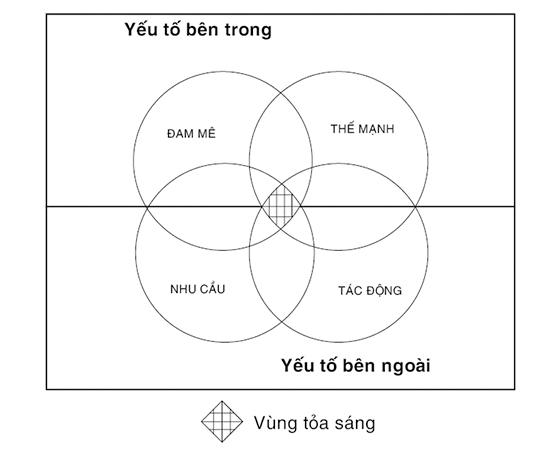
Diagram for establishing your zone of brilliance
Apply the Pareto principle
Tạ Minh Tuấn shared that when he first enrolled, he struggled with the general courses. But once he entered his specialization and took specialist subjects, he increasingly found that the field suited him very well. In several specialist subjects, Tuấn even had the highest grades in the class. He was trusted and elected class representative with nearly 100% of the vote. He was also active in activities such as football, starting an English club for the whole class and building a KPI system. Yet what is remarkable is… Tạ Minh Tuấn was almost the least frequent attendee in his class.
“Because I skillfully applied the principle ‘Minimum effort for maximum results.’ I chose a field that suited me well. Sometimes in life, choice matters more than effort,” the young entrepreneur shared.
Tạ Minh Tuấn shared an amusing memory of Project Management. He missed 90% of the classes, simply reading the materials at home and coming to class to take the exam. Yet his final grade was very high. When the teacher learned Tuấn's exam score, she shook her head and said, “Impossible.”
“Not attending class didn't mean I wasn't learning. I already had my second startup project then, meaning I was managing a real project in the world,” Tuấn shared. He applied his experience to answering exam questions. Theory always comes from practice, so his real business experience proved valuable, helping him answer accurately. Tạ Minh Tuấn's exam apparently earned one of the class's highest scores.
Working while studying also helped this young entrepreneur identify which 20% of classroom knowledge related to his ‘Zone of Brilliance’ he should focus on. So that this 20% of knowledge produces 80% of his work results. That is the famous Pareto 80/20 Principle, helping us “do less and achieve more.”
He concluded that this is precisely why working while studying helps you feel less uncertain: you already have practical experience, making it easier to recognize the 20% of knowledge that creates 80% of the results in your life. From there, you will be more focused.
Because he knew clearly what he wanted, Tạ Minh Tuấn focused only on the 20% of subjects he needed. Although he had not completed many general education courses in his first 3 semesters, he decided he needed only the specialist knowledge and would not need a degree from the University of Technology. Tuấn therefore made a significant choice: study most of the specialist subjects, then focus on starting a business and the “school of life,” without wasting more time or money “making up” general education courses he considered unnecessary.
Of course, he also emphasized that this was his personal decision, not a model lesson for young people to follow. We should not use “exceptional cases” as the standard for all society. For him, education remains extremely important—a path that helps many escape poverty, overcome inferiority, and reach success. Education is the path for many people with even fewer opportunities than I had. Although a university degree is becoming less valuable than before, it remains another “weapon” in our toolkit, so having one is still better than not.
“My decision to leave university was carefully considered and based on these factors: I had studied well and absorbed all the ‘essentials’ of my chosen major + Studying additional general subjects was unnecessary for me + I did not intend to use an engineering degree to find a job later; I studied for knowledge, not a diploma + I wanted to courageously let go and spread my wings in the open sky + I was starting a business then, the company had just successfully raised capital, and I needed to focus on my dream + I felt that ‘if I did not do it, I could not go on living,’ so I decided to listen to the call within me,” Tuấn concluded.
* This article draws on the book Before Dawn There Is Always Darkness – Tạ Minh Tuấn.
Original article on Cafebiz: http://cafebiz.vn/day-la-bi-quyet-tung-giup-cuu-hoc-sinh-chuyen-le-hong-phong-lot-top-forbes-under-30-vua-khoi-nghiep-2-cong-ty-van-dung-xep-hang-dau-cua-lop-du-khong-di-hoc-nhieu-20180522142832879.chn
>> Great Articles on Entrepreneurship
>> Success Energy Activation Course