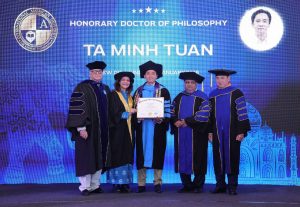
Starting a business while a second-year student at Ho Chi Minh City University of Technology, Tạ Minh Tuấn is now, at 29, Chairman and CEO of TMT Group.
 |
Starting a business while a second-year student at Ho Chi Minh City University of Technology, Tạ Minh Tuấn is now, at 29, Chairman and CEO of TMT Group, comprising businesses pioneering several fields in Vietnam. He built Vietnam's first private home healthcare system, the precursor to the later family doctor model, and was also the country's first entrepreneurship educator.
Beyond business, Tạ Minh Tuấn holds important roles in many business-networking organizations and community programs: Founder and Chairman of the Angel Legs Dream Fund, supporting people with disabilities passionate about business and the arts; founder of Vietnam Leaders Toatsmasters, part of Toastmaster International, currently the world's largest public-speaking association; former Chairman of BNI Master Chapter, part of the global business-networking organization in Vietnam; and former National Training Director of JCI Vietnam.
In 2011, thanks to his initiative to develop a home healthcare system, Tạ Minh Tuấn was selected by CSIP, the British Council, and the World Bank as one of Vietnam’s 15 outstanding social entrepreneurs. In 2015, he entered Forbes magazine’s list of Vietnam’s 30 most influential people under 30 (Forbes 30 Under 30 Vietnam 2015), and went on to join its Asia-wide list in 2016 (Forbes 30 Under 30 Asia 2016).
* You once said you wanted to use business to help make Vietnam a great place to live. Are you satisfied with what you have achieved so far?
– Last year, I had the chance to visit Israel, the “Startup Nation.” In the ancient city of Jerusalem, there is a famous place called the “Wailing Wall,” where Jewish people have prayed for thousands of years. Everyone who comes here shows absolute reverence, and many weep while praying. They believe that if they write a dream on a piece of paper and place it in a crack in the wall, that dream will come true.
I did the same, writing down my personal goals. But when I pressed my cheek against the wall, its energy seemed to “shake” me, and I cried like a child. I cried over war's absurdity and injustice, and the many people who lost their lives to it.
And at that moment, I decided not to put the paper listing my personal goals into the wall. Instead, I took another sheet and wrote a different wish: for the world to become peaceful and Vietnam a better place to live.
Returning home, I focused on helping Vietnamese people live better. I regard this as my life's mission, a long-term one. I am not yet satisfied with what I have done, but I am still happy. Satisfaction often makes us stop, losing the motivation to continue.
I am trying to develop all three areas: contributing to the physical strength, intellectual strength and inner strength of Vietnamese people. Healthcare concerns physical strength; education and training for aspiring entrepreneurs concern intellectual strength; social programs that help many people cultivate their hearts concern inner strength.
* To support entrepreneurs, why did you choose training rather than, for example, opening an “incubator” or establishing an investment fund?
– I chose to focus on startup education because I believe helping someone start a business systematically changes their future and their family's, and, above all, helps them avoid becoming a “dangerous entrepreneur.” A “dangerous entrepreneur” will cause… danger to many people.
Because if they fail and fall into debt, their loved ones and children suffer too. If they “succeed,” they create products that harm users for profit, seeking personal wealth while dragging society down. I want to help prevent this in entrepreneurs’ thinking from the very beginning of their business journeys. I want them to become “happy entrepreneurs.”
* In addition to running TMT Group's businesses, you also play an important role in many community organizations and programs. What do these activities mean to you?
– Dr. Muhammad Yunus (Bangladesh) created Grameen Bank, the first bank specializing in lending to poor people without collateral requirements. Interestingly, after several years of operation, Dr. Yunus found that poor borrowers' repayment rate at Grameen Bank was even higher than wealthy borrowers' repayment rate at other banks.
Almost all poor borrowers repay in full. This means that, when trusted, poor people can sometimes be more reliable than the rich. Dr. Muhammad Yunus received the 2006 Nobel Peace Prize for this innovation and became one of the world's first recognized social entrepreneurs.
To create such positive social impacts, I chose the path of a social entrepreneur. When choosing business projects, the most important thing I look for is whether their core values benefit society and create many positive impacts. I do not pursue ideas that can make a lot of money but harm society. Making that choice gives me great peace of mind.
If community activities have four levels—giving someone a fish, giving them a fishing rod, teaching them to fish, and giving them the motivation to fish (because even with a rod and fishing skills, without motivation they remain idle and cannot escape poverty)—we always want to run programs at the second level or above. One recent example is Journey Of Books (JOB, hanhtrinhsach.com).

* Could you share more about “The Book Journey”? Why did books become one of your choices for community activities?
– I had the idea of sharing books within the community back in 2009, when I wrote a note on my personal Facebook page called “The Journey of Books.” Last year, also during my trip to Israel, I had the chance to visit the home of David Ben-Gurion, the first prime minister of the “Startup Nation.” I was very surprised that a national leader's living space displayed none of the things like… fine liquor, rhino horns or ivory, but was full of books.
He left a legacy of around 20,000 books and a wish to turn his home into a library, but for various reasons that wish remained unfulfilled. After the trip, I felt even more strongly about an idea I had held for many years and wanted to make that Israeli prime minister’s wish a reality in Vietnam. At the end of 2016, Hanhtrinhsach.com was born. This is a nonprofit program that serves as a bridge for sharing and creates opportunities for young people to read books for free.
Books are excellent tools for motivating you to “go fishing” and also provide “fishing” knowledge. Reading is a way to learn from others' experiences, both successes and failures. Theory comes from one person's practice and should be applied to many people's practice. But books should serve only as references that broaden your perspective. Multiple perspectives provide a more complete view of truth, rather than being like “blind fortune-tellers feeling an elephant.”
Reading books is a way to seek truth: the truth about markets, products, target customers and suitable business models. Entrepreneurs need to read all the more, because they gain perspectives from other successful people and scholars.
* Through YUP Education, you have become a teacher, an inspiration to entrepreneurs, and an influential figure in Vietnam's startup community. From your frequent meetings and interactions, do you see any “common denominators” in the strengths and weaknesses of today's entrepreneurs?
– Today's startup community has a very strong entrepreneurial spirit, especially in a dynamic city like Ho Chi Minh City. Perhaps recognizing this, billionaire Richard Branson took a photo during his visit and posted it on Twitter with the caption, “This is the most vibrant startup city today.”
However, entrepreneurs have three notable weaknesses. First, they lack self-awareness and do not know what they want. Second, they lack an owner's mindset. Third, they lack foundational knowledge and skills in market research, business planning, sales, branding, fundraising, capital structure, and so on… Among these, understanding oneself is very important.
Many people want to do business merely to ‘keep up with others,’ follow a trend, or make profits. Profit is not bad, but how it is generated defines whether someone is an entrepreneur or merely a ‘trader.’ True entrepreneurs do not profit by harming society. Business is only a means to fulfill life's goals. Life goals must therefore precede and govern business goals. Otherwise, entrepreneurs cannot master their companies; their companies master them.
* In your view, what do a leader's or executive's personal values mean for a company or organization?
– An entrepreneur's heart is reflected in the products and services they create. A superficial person creates superficial products; a refined perfectionist creates a flawless product. Moreover, they attract people like themselves to their team. That team creates the company's products and also its culture. So we can say that company culture originates in the leader's culture.
* How has the development direction of TMT Group's business areas changed?
– My healthcare business originated in the pain of having a loved one with cancer. From that, I applied systems thinking to design a home healthcare model. I identified this as something I needed to do and had to make more widespread to improve people's healthcare, prevent illness effectively before treatment was needed, help reduce hospital overcrowding and save costs for people and society.
However, this is not my passion. After reaching the milestone of caring for over 10.000 Vietnamese families, I feel HELP International has fulfilled its initial mission. Healthcare business through HELP International will therefore continue but develop through franchising. I want to devote more time to education and training because I recognize their tremendous meaning and impact.
* Thank you, and may your business and community activities have an increasingly positive impact on society!