The film “Let Me Tell You, Dad” has done something truly commendable: sounding a wake-up call about mental health in today’s society, especially among young people.
In an era when achievement, speed, image, and comparison create constant pressure, many young people carry invisible wounds. They still attend school and work, smile and talk, post photographs, and remain “fine” by society's standards. But inside, many are cracking, depleted, lonely, and bewildered about their own existence. A film that dares touch that darkness, even imperfectly, is an effort worth recognizing.
In terms of wording, the proper Vietnamese term is ‘sức khoẻ tâm thần’—mental health. But if ‘tâm thần’ leads people to prejudice, shame, fear, or labeling themselves with an illness more severe than reality, we can still use ‘sức khoẻ tinh thần,’ a gentler everyday expression for mental health. Fundamentally, both refer to the same thing: a person's inner condition, how emotions, thoughts, memories, and a sense of meaning are functioning. Words are only a means. What matters is helping people dare to face their situation and seek help.
Viewed therapeutically, the film's ending is not truly healing in the full sense. It has not reached a sufficiently deep, safe, and structured psychological recovery process. But this is understandable: the filmmakers may never have truly been healers or mental health therapists. They are telling a story through empathy and the intuition of people living life, rather than the clinical experience of someone who has worked through many cases of inner trauma.
The film still contains details worth examining from a therapeutic perspective. For example, the scene where the foreign female “psychology expert” wants to hug the boy Minh. In that context, it is not real therapy. It is not “right therapy.” For a client carrying deep wounds, especially around boundaries, safety, and trust, a sudden hug, however well-intentioned, may reactivate trauma rather than heal. Therapy is not acting on the therapist's emotions. It is a highly sensitive process with boundaries, professional ethics, structure, and deep listening to the client's nervous system and trauma history. This detail therefore signaled to me early that the therapy center in the film was not reputable. Everything that followed in the plot reflected exactly that (a slight spoiler here).
Although there are aspects that could improve, I still choose to support the film's benevolent spirit. At the beginning of the year, as a way of offering loving-kindness, I will also accept around 8–10 mental health cases involving depression, anxiety disorders, existential confusion, prolonged insomnia, psychological trauma, and even more severe conditions such as schizophrenia at a level where supportive intervention remains possible. Some physical conditions involving the spine, bones and joints, or other issues deeply connected to mind and body may also be considered.
This is not a commercial program. It is more like an expression of the loving-kindness we want to offer at this time. I will personally follow the progress of these cases rather than delegate them entirely to the team.
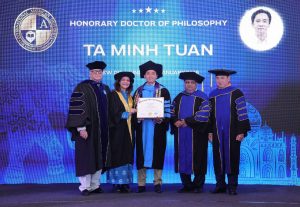
And I would like to add something very personal but sincere: I see this work as an expression of gratitude after recently receiving an honorary doctorate in mental health from the United States. It is not a title to embellish my personal image, but a gift, a gentle yet profound reminder that the path I am walking is in the right direction, and the responsibility that comes with it is greater too.
So for me, the cases accepted this time are more than simply helping people.
I still use many modern psychological tools. And let me be very clear: some matters should simply be left to the appropriate psychology professional. The right person for the right task. Respect expertise. There is no question of denying the role of clinical psychology or medicine.
However, I must also say plainly something many in the profession understand: learning much theory does not automatically make you able to provide therapy. Some experts carry many concepts, models, and implicit prejudices, yet have never truly sat still enough with another person's pain. They analyze and label well but lack the presence to guide a true healing process.
Our approach is harmony. We do not reject psychology, nor do we mystify spirituality. We combine both. We conduct mental and spiritual therapies, including practices for healing, consciousness, meditation, releasing traumatic memories, and reestablishing a safe relationship between people and themselves.
Because ultimately, the roots of many mental disorders lie not only in brain chemistry, but in a heart abandoned for too long, a soul that has lived in the wrong role for too many years, and a person who was never taught how to sit quietly with their own pain.
If this film helps one more person dare to say, ‘I am not okay. And I need help,’ it has accomplished something great.
As for the rest, we—standing at the intersection of psychology and spirituality—have a responsibility to step in with humility, awareness, and compassion.
You can register by messaging me directly with your full name, phone number, and the issue you would like support with. With your permission, I will forward this information to the intake and scheduling team, and I will follow this support process.
You can also #Share (share) this article, because it may reach someone who needs it.
With sincere thanks,
Tạ Minh Tuấn